

Please read this first. Denver Regenerative Medicine is an orthopedic and pain practice in Colorado. We do not treat cancer. We do not perform stem cell transplants. We have nothing to offer for multiple myeloma, and we are not seeking myeloma patients.
We wrote this page because “stem cells” means two completely different things in medicine, and that confusion sends people to the wrong clinics at the worst possible moment. If you or someone you love has multiple myeloma, your care belongs with a hematologist-oncologist and, if transplant is being considered, an accredited transplant center. This page is here to explain the terminology, not to offer you anything.
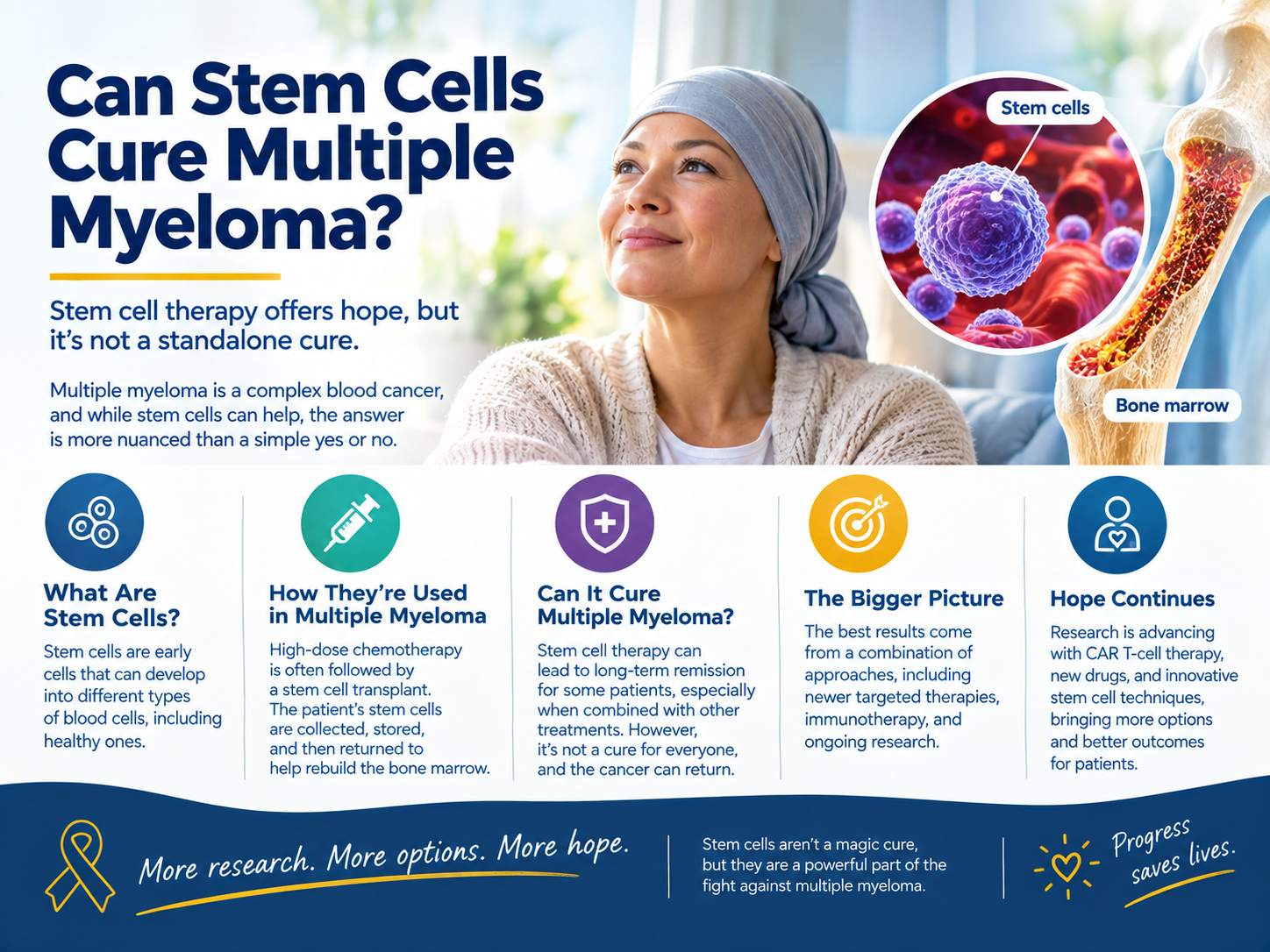
No. Stem cell transplant does not cure multiple myeloma.
It is, however, a genuine and important part of standard treatment for many patients, and it is not a fringe therapy. Autologous stem cell transplant is considered standard of care for newly diagnosed myeloma patients who are healthy enough for it, and it is used at major cancer centers worldwide.
The honest framing is this: myeloma is currently considered treatable but generally not curable. Transplant is one of the most effective tools for pushing the disease into a deep and durable remission. For most patients, the disease eventually returns, though a minority achieve remarkably long remissions, with published data showing roughly 15% of patients remaining progression-free for eight years or more after transplant.
That is a meaningful thing. It is not the same as a cure, and any source telling you otherwise is not being straight with you.
Two Completely Different Things Are Called “Stem Cell Therapy”
This is the confusion worth clearing up, because it has real consequences.
1. Hematopoietic stem cell transplant (what myeloma treatment involves)
This uses hematopoietic stem cells, the cells in your bone marrow that produce blood and immune cells. In myeloma treatment, these cells are collected from your bloodstream, stored, and given back to you after high-dose chemotherapy.
This happens at accredited transplant centers, under the care of hematologist-oncologists, over weeks of inpatient or closely monitored outpatient care. It is a serious, established, evidence-based cancer treatment.
2. Mesenchymal stem cell and orthobiologic injection (what regenerative clinics like ours provide)
This uses mesenchymal stem cells and other biologic material from bone marrow or fat tissue, injected into a joint or tendon to address arthritis, cartilage wear, or tendon damage. It is an outpatient injection performed for musculoskeletal problems.
These are different cells, used for different purposes, in different settings, by different specialists. The orthopedic version has nothing to do with treating cancer, and no clinic offering joint injections is equipped to treat myeloma. That includes us.
If a clinic that advertises joint injections offers to treat your cancer, leave.
What the Transplant Actually Does
The logic is more straightforward than the name suggests.
Chemotherapy kills myeloma cells, and higher doses kill more of them. The limiting factor is that high-dose chemotherapy also destroys the bone marrow, which you cannot live without.
The transplant solves that problem. Your own stem cells are collected and frozen beforehand. You then receive high-dose chemotherapy, typically melphalan, at a dose that would otherwise be intolerable. Your stored stem cells are returned by infusion afterward, where they rebuild your bone marrow over the following weeks.
The stem cells are not the treatment. The chemotherapy is the treatment. The stem cells are the rescue that makes the dose possible. This distinction matters, because it explains why the procedure does not “cure” anything on its own and why it is one step in a longer sequence.
The term “autologous” means the cells are your own. That is what makes this different from the donor transplants used in some other blood cancers.
Where Transplant Fits in Modern Myeloma Treatment
Transplant is not a standalone event. It sits inside a sequence, and much of the improvement in myeloma outcomes over the past decade has come from what happens before and after it rather than from the transplant itself.
A typical course for a transplant-eligible patient looks broadly like this:
- Induction therapy. Drug treatment to reduce the disease before transplant. The current standard for transplant-eligible patients is a four-drug combination: an anti-CD38 monoclonal antibody such as daratumumab or isatuximab, a proteasome inhibitor such as bortezomib or carfilzomib, an immunomodulatory drug such as lenalidomide, and dexamethasone.
- Stem cell collection. Your cells are mobilized into the bloodstream, collected, and frozen.
- High-dose chemotherapy and transplant. The conditioning chemotherapy is followed by reinfusion of your stored cells.
- Maintenance therapy. Ongoing lower-intensity treatment to keep the disease suppressed.
Outcomes with this sequence have improved substantially. Published data on four-drug induction followed by transplant and maintenance has reported roughly 85% of patients remaining progression-free at four years. Myeloma today looks very different from myeloma twenty years ago.
It still is not framed as cured, and your oncologist is the only person who can tell you what any of this means for your particular disease.
What About Donor Transplants?
Allogeneic transplant, which uses stem cells from a donor rather than your own, is the one approach in myeloma that has ever been described as potentially curative for a small number of patients. The donor immune system can recognize and attack remaining myeloma cells, an effect known as graft-versus-myeloma.
It also carries substantially higher risks, including serious treatment-related mortality and graft-versus-host disease. For that reason, it is used rarely in myeloma and largely within clinical trials or in selected high-risk situations. It is not a standard option, and it is not something to request without a detailed conversation with a transplant specialist.
What About CAR-T and the Newer Therapies?
You may have seen striking results reported for CAR-T cell therapy and bispecific antibodies in myeloma. These are genuine advances, and they have changed what is possible for patients whose disease has returned after other treatments.
They are worth understanding correctly: these are immune cell therapies, not stem cell therapies. CAR-T uses your T cells, a type of immune cell, which are collected and genetically engineered to recognize myeloma cells. Bispecific antibodies are drugs that connect your T cells to myeloma cells. Neither is a stem cell treatment, and neither is currently described as curative.
They belong in the conversation with your oncologist about what comes next, not in a conversation about stem cells.
Be Careful Who You Trust With This Question
A myeloma diagnosis is exactly the circumstance that predatory clinics look for, and the words “stem cell” are the hook.
The Federal Trade Commission has brought enforcement actions against stem cell clinics and marketing operations for deceptive and unsubstantiated claims that their therapies could treat or cure serious diseases, including actions that ended in permanent bans and multimillion-dollar judgments. The FDA has issued warning letters to clinics marketing unapproved cell products and ended its enforcement discretion period for the regenerative medicine framework in 2021.
Signs you are talking to the wrong people:
- A clinic that is not a cancer center offering to treat your cancer
- Any promise of a cure, or pressure to decide quickly
- Treatment requiring large out-of-pocket payment for a cancer therapy, particularly abroad
- Claims that the same injection treats many unrelated conditions
- Advice to stop or delay your oncologist’s treatment plan
- Testimonials substituting for published evidence
Legitimate myeloma treatment happens in cancer centers, is covered by insurance in the ordinary course, and is delivered by hematologist-oncologists who will tell you plainly what is known and what is not.
Where to Get Reliable Information
- Your hematologist-oncologist. Nothing on this page or any page replaces the person who has seen your labs, your imaging, and your biopsy.
- The National Cancer Institute (cancer.gov), for current treatment information.
- The International Myeloma Foundation and the Multiple Myeloma Research Foundation, for patient education and support.
- The Leukemia & Lymphoma Society, for patient support and financial navigation resources.
- ClinicalTrials.gov, for trials you may be eligible for. Ask your oncologist whether a trial makes sense for you.
If you have been offered a stem cell treatment for myeloma by anyone other than an oncologist at an accredited center, take that offer to your oncologist before you take it seriously.
This article is general education about terminology and is not medical advice. It is not a description of any service offered by Denver Regenerative Medicine. We are an orthopedic and pain practice, and we do not treat cancer, do not perform stem cell transplants, and offer no treatment for multiple myeloma. If you have myeloma or suspect you might, contact a hematologist-oncologist.
Frequently Asked Questions
Can stem cells cure multiple myeloma?
No. Autologous stem cell transplant is standard treatment for many newly diagnosed myeloma patients and can produce deep, durable remissions, but it is not curative. Myeloma is currently considered treatable but generally not curable. Published data shows roughly 15% of patients remain progression-free for eight years or more after transplant, which is meaningful but is not a cure.
Is a stem cell transplant for myeloma the same as stem cell therapy for joints?
No, and the difference matters. Myeloma transplant uses hematopoietic stem cells to rebuild bone marrow after high-dose chemotherapy, performed at accredited transplant centers by hematologist-oncologists. Orthopedic stem cell therapy involves injecting biologic material into a joint or tendon for arthritis or tendon damage. Different cells, different purposes, different specialists. A clinic offering joint injections is not equipped to treat cancer.
What actually treats the myeloma in a transplant?
The high-dose chemotherapy does. The stem cells are collected beforehand and returned afterward to rebuild the bone marrow, which the chemotherapy destroys. The stem cells make the chemotherapy dose survivable rather than treating the cancer themselves.
Is a donor stem cell transplant a cure for myeloma?
Allogeneic transplant using donor cells has been described as potentially curative for a small number of patients, because the donor immune system can attack remaining myeloma cells. It also carries substantially higher risks, including treatment-related mortality and graft-versus-host disease, so it is used rarely in myeloma and largely within clinical trials or selected high-risk cases. Discuss it with a transplant specialist.
Is CAR-T therapy a stem cell treatment?
No. CAR-T uses T cells, a type of immune cell, which are collected and genetically engineered to recognize myeloma cells. Bispecific antibodies work by connecting your T cells to myeloma cells. Both are immune cell therapies rather than stem cell therapies, and neither is currently described as curative.
Does Denver Regenerative Medicine treat multiple myeloma?
No. We are an orthopedic and pain practice in Colorado. We do not treat cancer of any kind, we do not perform stem cell transplants, and we have no treatment to offer for multiple myeloma. Myeloma care belongs with a hematologist-oncologist.
 How Much Is Stem Cell Therapy in Houston?
